
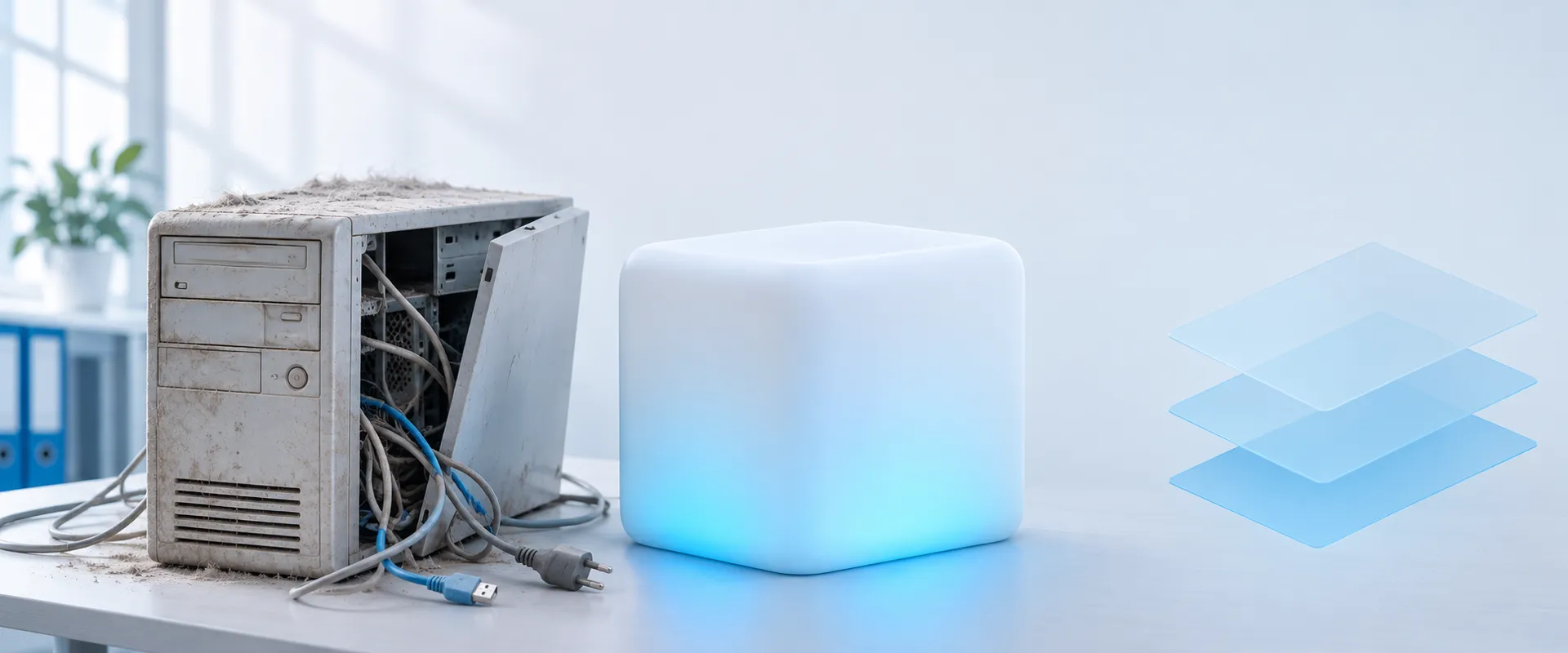
The phone call usually goes like this: a customer mentions that searching for your company name brings up pages about online casinos. Or a browser shows a red warning before your home page loads. By then the site has often been compromised for months.
Very often the root cause is not a sophisticated attack. It is software on the web server that nobody has updated in years - and in October 2026 that software got a very public reminder of why updates matter.
The October 2026 advisory, in plain terms
On 21 October 2026 the PHP project released urgent updates for two critical vulnerabilities, CVE-2026-109618 and CVE-2026-109619, each scored 9.2 on the CVSS 4.0 scale. Exploiting them requires no account and no password: a crafted web request is enough to execute code on the server. The PHP team called on all users to update immediately (read the advisory on php.net).
Where does that leave a typical business website? It depends entirely on the PHP version it runs:
| PHP version | Patched release | Official support |
|---|---|---|
| 8.5 | 8.5.12 | active support until end of 2027 |
| 8.4 | 8.4.27 | active support until end of 2026, then security fixes until end of 2028 |
| 8.3 | 8.3.36 | security fixes only, until end of 2027 |
| 8.2 | 8.2.35 | security fixes only, ending 31 December 2026 |
| 8.1 and older | none from the PHP project | end of life |
The last two rows are the problem. A site on PHP 8.1 or earlier received no official fix at all - only some hosting providers and Linux vendors backport patches for their own customers. And a site on 8.2 is protected today, but will be in the same position in a matter of weeks.
The PHP team also published temporary mitigations, with a clear caveat: they lower the exposure, but only updating removes it.
Three questions business owners ask us
"The site works fine. Why should I care?" Because "works" only means the pages load. Attack tools don't look for interesting companies - they scan millions of addresses for known weaknesses and break in wherever the door is open. A small, quiet website is just as attractive to them as a big one, often more so, because nobody is watching it.
"Isn't this my hosting company's job?" Partly. The host keeps the server running, but on shared hosting the PHP version is usually a setting in your control panel - and many hosts keep offering versions that are long out of support so that old sites don't break. On top of PHP sit WordPress, a theme and a stack of plug-ins, and those are the site owner's responsibility.
"We were hacked once and had it cleaned. Aren't we done?" Not necessarily. Clean-ups often remove the visible damage but miss a hidden backdoor, or leave open the hole the attackers came through. Getting reinfected is common. And even a perfect clean-up leaves you with the same software that needs patching every month.
A case from this autumn
Recently we took on two hotel websites in London that had been broken into. Both were WordPress sites built with a page builder, hosted on shared hosting and left without maintenance for years. We can't point to the exact entry point - with an outdated stack there were several candidates - but the damage was easy to see.
On both sites the attackers had planted a script in the page header that pulled code from an outside domain for every ordinary visitor, while showing a clean page to anyone logged in as an administrator. That is why the owners hadn't noticed. Under the hotels' own domains the attackers had also published thousands of spam pages - casino promotions and similar - added fake sitemaps to robots.txt to get roughly ten thousand of those addresses indexed, slipped a crypto link into the home page text and left dozens of spam posts and comments. One of the hotels had also lost its entire photo library.
Why a hacked website is also a compliance issue
This is the part most owners don't expect. If your website has a contact form, a booking form or a newsletter sign-up, a script injected into your pages can read whatever visitors type in. That makes a website break-in a potential personal data breach under GDPR:
- The controller must notify the supervisory authority within 72 hours of becoming aware of the breach, unless it is unlikely to result in a risk to people's rights and freedoms (Article 33).
- If the risk is high, the people affected must be told as well (Article 34).
- Every breach has to be recorded internally, including the ones you decide not to report.
In other words, an unmaintained website is not only an IT problem but a compliance one - and the 72-hour clock starts when you find out, not when you have time to deal with it. Handling exactly these situations is part of our GDPR consulting.
Our approach: take away the attack surface
Instead of guarding a complicated application, we remove it. We rebuild sites like these as static websites: the content - pages, rooms, prices, FAQs, blog posts - is recovered from the old site, moved into a modern framework and published as ready-made HTML files. The difference in what is exposed to the internet is stark:
| Typical WordPress site | Static site we build | |
|---|---|---|
| Code running on the server for each visit | PHP, WordPress, theme, plug-ins | none |
| Database reachable from the web | yes | no database |
| Admin login on the public site | yes, on a well-known address | none |
| Routine updates | core, theme and plug-ins, constantly | server only, handled by us |
| Old spam addresses after the rebuild | often still indexed | answered with 410 Gone |
A few details are worth spelling out:
- The spam gets cleaned out of search results. Every leftover spam URL answers with 410 Gone, which tells search engines the page has been removed permanently - they drop such pages faster than ordinary "not found" errors. Real pages from the old site are redirected to their new addresses so that existing rankings are kept.
- Speed comes for free. With nothing to compute on each request, pages load immediately. Photos are converted to modern formats in several sizes, with dedicated crops for phones. The two hotel sites score 100 for accessibility and 100 for SEO in a mobile Lighthouse test, with performance on the home pages ranging from the mid 80s to the 90s.
- Search engines and AI assistants understand the business. Each site describes the hotel in structured data, publishes a sitemap and an llms.txt summary, and its robots.txt invites search and AI crawlers in.
- Bookings and enquiries still work. Reservations go through the hotel's existing booking engine; parking and airport transfer requests go straight to the hotel's mailbox.
Content updates remain simple: you send us new text or photos and the change is live by the next day.
A five-minute self-check
- Look up your PHP version in the hosting control panel. If it starts with 8.1 or lower, you are running unsupported software today; 8.2 joins it on 1 January 2027.
- Search Google for
site:yourdomain.comand scroll through the results. Any page you don't recognise - especially in another language - is a red flag. - Open Google Search Console and check the Security issues report. Google lists detected hacking and malware there.
- List who has admin access to the website and the hosting account. Former employees and agencies you no longer work with should not be on it.
- Check where your forms send data and whether that is described in your privacy policy. If you don't know, neither will you after a breach.
The takeaway
An unpatched PHP website is a liability on two fronts: it can be taken over in minutes, and when that happens it can trigger legal obligations you have three days to meet. For most company websites there is a simpler path - a static site with nothing on the server to break into, which also happens to be faster and better for search.
If your website runs on an old PHP version, has already been hacked, or you are simply not sure, see how we build websites or book a free call and we will tell you honestly what makes sense.