More and more restaurants in Poland serve guests from abroad - tourists, expats, international corporate staff. At the same time most venues have staff who speak Polish (and sometimes English, with very mixed proficiency). The language barrier costs: worse guest experience, more order mistakes, worse reviews on international platforms.
The simplest fix doesn't require hiring translators or teaching servers five languages. The menu itself just needs to speak the guest's language - and that is exactly what the enumenu.com QR menu does.
The challenge
A guest who walks into a Polish restaurant from Norway or Ukraine has a typical chain of questions:
- What is on the menu? What does that ingredient mean?
- Are there vegan / gluten-free / halal options?
- How do I order if I can't read the card or the table number?
- How much does this cost?
In a traditional restaurant each of those needs a person who can answer in the guest's language. For most venues that is unrealistic. The result: fewer orders, mistakes, worse ratings in international booking apps.
The menu in the guest's language - automatically
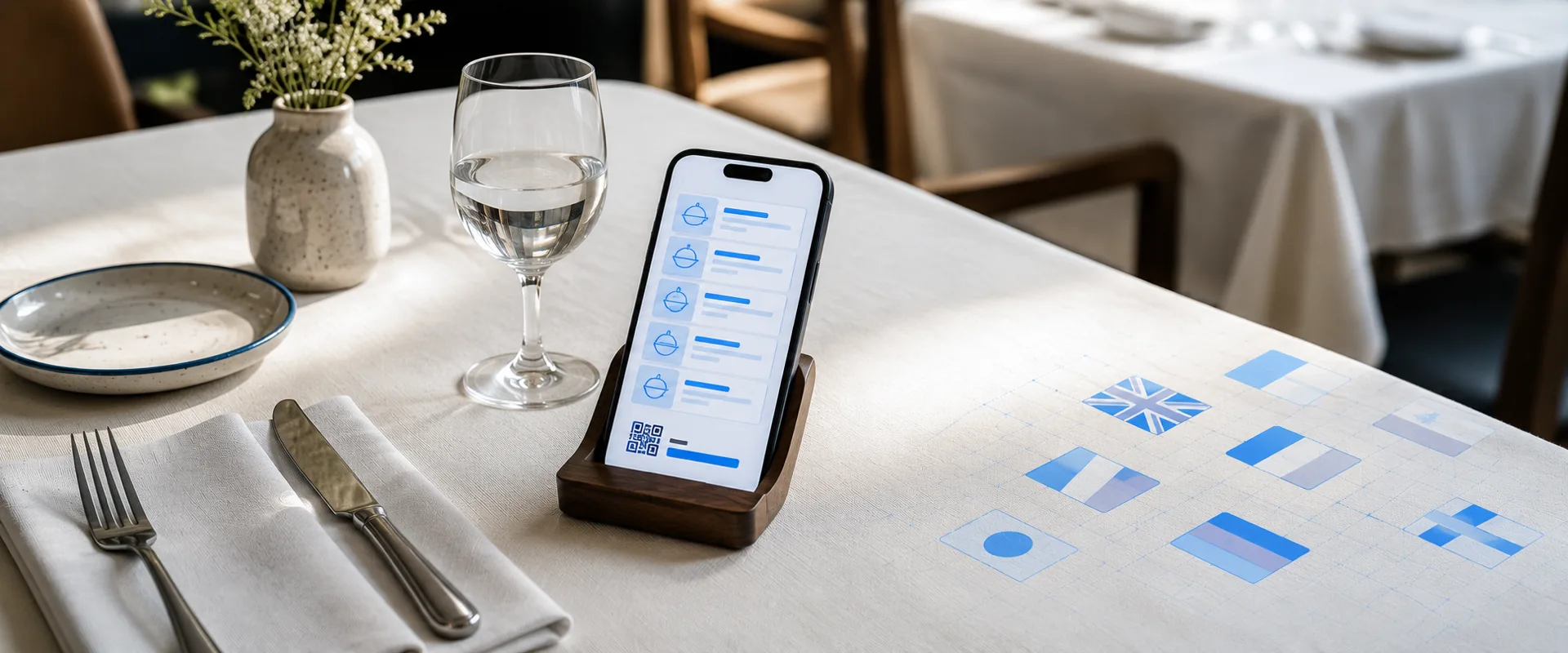
The solution is simple: the guest walks in, sees a QR code at the table, scans it with the phone camera. The menu opens in the browser in their language - because enumenu detects the browser language and picks the right version of the card automatically. A German sees the menu in German, a Ukrainian in Ukrainian, a Spaniard in Spanish - with no extra tap.
Importantly, you are not limited to "a few popular languages". You can run the card in any language your guests need - from English and German, through Ukrainian and Czech, to non-European languages. Adding another language version is a matter of configuration, not rebuilding the whole menu.
What else the guest understands
The card itself is not everything. enumenu gives an international guest the full set of information usually missing from a paper menu:
- Dish photos - critical for guests from outside European food cultures who don't recognise dish names.
- Full allergen labelling (the 14 allergens per EU Regulation 1169/2011) - described in the guest's language, not just symbols.
- Diet markers - vegetarian, vegan, gluten-free, halal.
- Clear prices - no misunderstanding at the bill.
Less work for the staff
From the menu the guest can also do things themselves:
- call the waiter with one tap (the alert pops up in the staff dashboard),
- request the bill the same way,
- place an order that goes straight to the kitchen printer - with notes in the kitchen's language, not the guest's.
The result: the guest understands the offer, the kitchen understands the order, and the server doesn't have to translate culinary vocabulary or run between tables. Fewer mistakes, faster turnover, better reviews.
Rollout step by step
How this looks operationally on our side:
- Day 1. You email us a photo of the current menu or a PDF.
- Day 2. We import the menu and add the language versions you need.
- Day 3. We print QR codes (laminated, restaurant-grade) and courier them to you.
- Day 4. We configure allergens, diets and - if you want - at-table ordering with a kitchen printer.
- Day 5. A short live test with staff.
enumenu's free plan covers 1 table with no time limit - you start with a test, and only when you see the impact do you move to a full rollout.
Next step
If you run a restaurant where you increasingly hear languages your staff don't speak, take a look at enumenu.com - QR table service.
The first consultation is free - in 30 minutes we'll walk you through a live demo.